
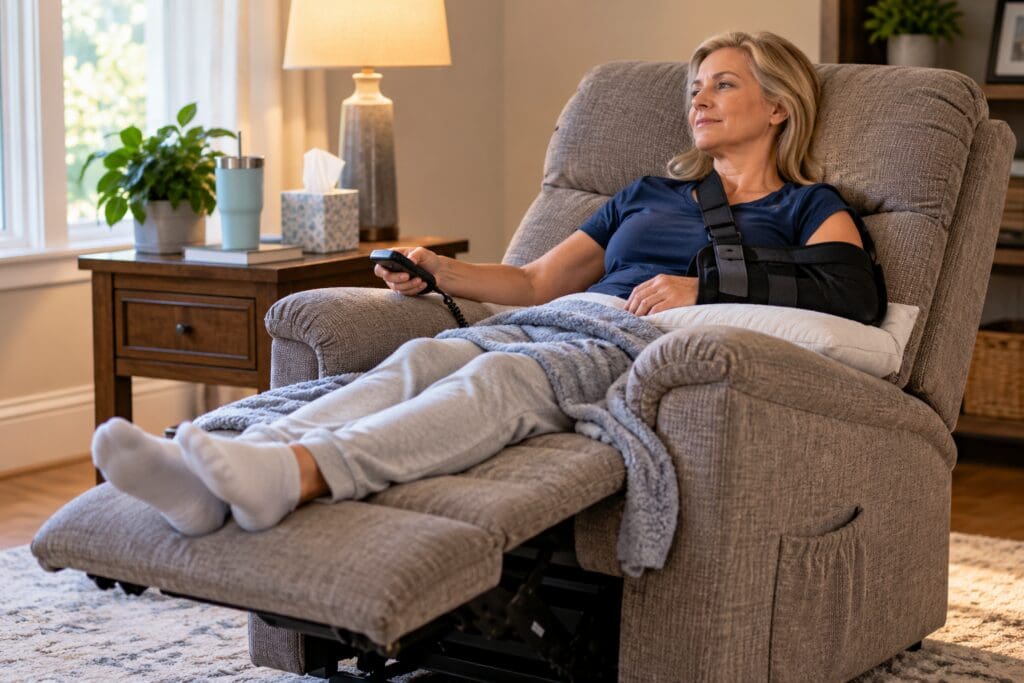
Recovering from shoulder or rotator cuff surgery creates challenges you may not anticipate before the procedure. You expect difficulty lifting your arm or reaching overhead, but everyday movements like getting out of a chair, lowering yourself onto a sofa, and finding a comfortable sleeping position can also become difficult.
A power lift chair can be particularly helpful during this type of recovery because it reduces how much you need to push with your arms when sitting or standing. It can also provide an adjustable, elevated place to rest when sleeping in a traditional bed is uncomfortable.
At Comfort Medical Supply, we can help you choose a lift chair before a planned surgery so you have the right setup waiting when you return home.
Why Getting Out of a Chair Can Be Difficult After Shoulder Surgery
Think about how you normally stand from a chair. Most of us lean forward, place one or both hands on the armrests, and push ourselves upward.
After shoulder surgery, that seemingly simple movement may conflict with your postoperative restrictions.
For example, Cleveland Clinic’s shoulder replacement recovery guidance advises patients to avoid using the newly replaced shoulder to lift themselves from a bed or chair for approximately six weeks. Restrictions following rotator cuff repair or other shoulder procedures can differ, so you should always follow the specific instructions given by your surgeon.
This is one reason a deep sofa or low recliner can become particularly inconvenient during recovery. You may suddenly be trying to stand using primarily your legs and unaffected arm while protecting the surgical shoulder.
How a Lift Chair Reduces the Need to Push With Your Arms
This is where the lifting mechanism can make a meaningful difference.
Instead of pushing down hard on the armrests to get yourself upright, the chair gradually raises and tilts the seat forward. Once your feet are securely positioned underneath you, you’re much closer to a standing position.
The process works in reverse when sitting. You can back up to the raised chair and use the motor to gradually lower yourself rather than dropping into a low seat and relying heavily on your arms to control the descent.
The goal isn’t to eliminate movement. It’s to make the transition easier while reducing unnecessary reliance on the recovering shoulder.
Sleeping Can Be One of the Hardest Parts of Recovery
Finding a comfortable sleeping position after rotator cuff surgery can be frustrating.
You may be wearing a sling or immobilizer, and lying in your usual position may not be practical. Even getting into and out of bed can involve pushing, pulling, and repositioning movements that are difficult when one arm is restricted.
A power lift chair provides another option because you can adjust your upper-body position using the hand control instead of repeatedly repositioning yourself or building a complicated arrangement of pillows.
If you’re considering sleeping in a lift chair after surgery, talk with your surgeon first. Your procedure, repair, sling requirements, and postoperative restrictions should determine the position that’s appropriate for you.
Why an Infinite-Position Lift Chair May Be Worth Considering
Not all lift chairs move the same way.
If you mainly need assistance standing, a simpler lift chair may be sufficient. But if you expect to spend significant time resting—or potentially sleeping—in the chair, an infinite-position model deserves consideration.
These chairs can allow the back and footrest to operate independently. That means you can adjust your upper body without necessarily changing your leg position at the same time.
Some models also include:
- Power headrest adjustment
- Power lumbar support
- Independent footrest controls
- Multiple reclining positions
Those features give you more ways to find a comfortable position without physically shifting yourself around the chair.
Supporting the Surgical Arm Matters
Your recovering arm needs to be considered when choosing the chair itself.
Johns Hopkins Medicine’s rotator cuff repair guide explains that patients may be sent home with a sling or immobilizer after surgery and should continue using it as directed by their healthcare provider.
That’s why we wouldn’t choose a chair based solely on how soft it feels.
There needs to be enough room to accommodate your sling or immobilizer comfortably. The chair should also give you room to use appropriate pillows or other positioning support if your surgeon recommends them.
Don’t Choose a Chair That’s Too Deep
A giant, plush recliner might look like the most comfortable choice for recovery, but bigger isn’t necessarily better.
If a seat is too deep, you may have to scoot your body toward the edge before you can stand. Without thinking about it, you may instinctively push against the chair with your surgical arm.
The same problem can occur when a chair is too low.
When we’re helping someone choose a lift chair, we look at measurements such as:
- Seat height
- Seat depth
- Seat width
- Back height
- Armrest position
Your feet should be able to reach the floor appropriately when seated, and you shouldn’t have to struggle to reposition yourself just to use the lift function.
Keep the Hand Control on Your Unaffected Side
This is an easy detail to overlook before surgery.
Think about which arm will be immobilized and where you’ll keep the chair’s hand control.
You should be able to reach and operate it comfortably with your unaffected hand without twisting, reaching across your body, or repeatedly moving the surgical shoulder.
It’s also worth creating a small recovery station next to the chair. Keep frequently used items such as your phone, water, remote controls, tissues, medications, and reading material within easy reach of your unaffected arm.
Setting this up before surgery can eliminate a lot of unnecessary reaching afterward.
A Lift Chair Can Help Caregivers, Too
Someone who is normally completely independent may need assistance during the first stages of shoulder surgery recovery.
Without a lift chair, a spouse or family member may be tempted to physically help the person up from a low seat. That can create an awkward transfer for both people.
A lift chair changes that interaction.
The motor provides much of the elevation while the caregiver can concentrate on stability and making sure the area around the chair is clear.
It can provide greater independence for the person recovering while reducing the amount of physical assistance required from the caregiver.
Recovery Still Requires Movement and Rehabilitation
A comfortable lift chair shouldn’t become a place where you remain all day.
Rehabilitation is an important part of shoulder surgery recovery. Your surgeon and physical therapist will determine when and how you should begin moving the shoulder and gradually return to normal activities.
A lift chair should support that recovery plan by making it easier to transition between resting and activity—not replace prescribed movement or physical therapy.
Features We Would Consider After Shoulder Surgery
If you’re specifically choosing a lift chair for rotator cuff or shoulder surgery recovery, we would pay particular attention to:
- A smooth powered lifting mechanism
- Proper seat height and depth
- Infinite-position capability if you plan to sleep in the chair
- Independent back and footrest controls
- Power headrest adjustment when appropriate
- Power lumbar support
- A hand control that can be positioned for the unaffected hand
- Adequate room for a sling or immobilizer
- Battery backup
The right combination depends on your size, mobility, procedure, and how you expect to use the chair.
Consider Choosing Your Lift Chair Before Surgery
If your procedure is scheduled in advance, shopping for the chair beforehand has a major advantage: you can try it while you still have full use of both arms.
Sit in the chair and pay attention to how your body fits. Operate the controls. Try standing while intentionally avoiding pushing with the arm that’s going to be operated on.
At home, make sure there’s enough clearance for the chair to recline and lift properly. Position frequently used items on your unaffected side and eliminate power cords or other obstacles from your walking path.
You’ll then return home from surgery to an environment that’s already prepared for your recovery.
Let Us Help You Find the Right Lift Chair
At Comfort Medical Supply, we can help you compare lift chairs before shoulder or rotator cuff surgery and find one that actually fits your body and anticipated recovery needs.
We’ll look at seat height, seat depth, positioning options, controls, armrest design, and how you plan to use the chair. If you’re considering sleeping in it during the early stages of recovery, we can also show you models that provide greater control over your reclining position.
You can visit our Richmond location, our Fredericksburg location, or our Williamsburg location to sit in different chairs and experience the lifting and positioning functions yourself.
If you have surgery coming up and aren’t sure which type of chair would work best, reach out and let us know what you’re looking for. We’ll help you narrow down your options.
Making Recovery at Home More Comfortable
A lift chair won’t make a rotator cuff or shoulder repair heal faster, but it can address some of the everyday challenges that come with protecting one shoulder.
It can reduce how much you rely on your arms when getting up, provide an adjustable place to rest, make elevated positioning easier, and reduce the physical assistance you may need from a caregiver.
When you’re protecting a healing shoulder for weeks, making those routine movements easier can make recovery at home much more manageable.