
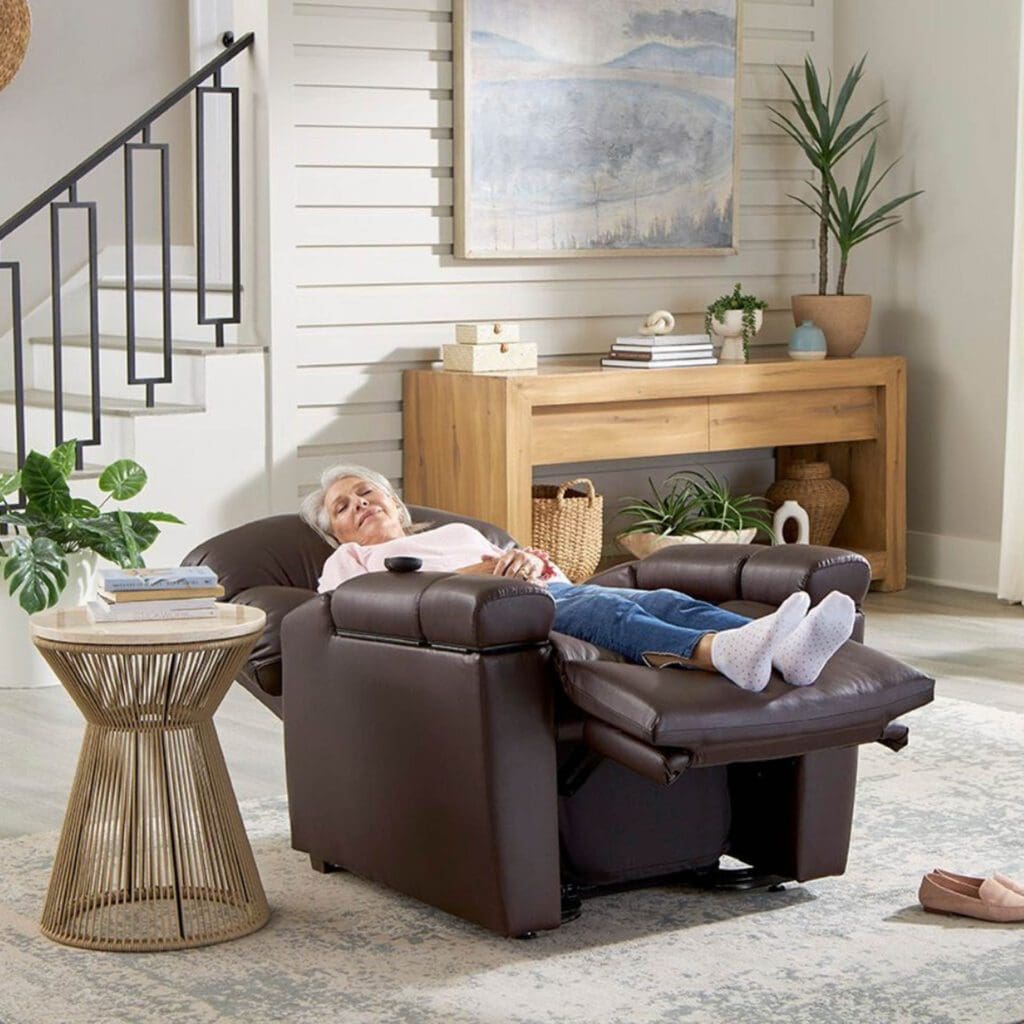
Many people use the terms “lift chair” and “power recliner” interchangeably. They are not the same.
Both plug into the wall. Both recline at the push of a button. Both look similar from the outside.
The difference is in the lift mechanism and who the chair is designed to help.
If you’re deciding between the two, this guide will help you understand which one fits your needs.
What Is a Power Recliner?
A power recliner is a chair that reclines electronically. Instead of pulling a lever, you press a button to lean back and extend the footrest.
Power recliners are designed primarily for comfort. They are ideal for:
- Watching TV
- Reading
- Relaxing
- Taking short naps
They do not assist you in standing up.
When you want to get up, you still need to use your legs and core strength.
What Is a Lift Chair?
A lift chair includes a motorized lifting mechanism that gently tilts the chair forward, helping you move from a seated to a standing position.
This is the key difference.
A lift chair is built for people who:
- Struggle to stand from a seated position
- Have knee, hip, or back pain
- Have balance concerns
- Are recovering from surgery
- Experience muscle weakness
The lift function reduces strain on joints and lowers fall risk during transitions.
The Mechanical Difference
A power recliner moves backward.
A lift chair moves backward and forward.
The forward tilt is what helps you stand safely. Without that feature, the chair functions like a standard recliner.
If standing up feels difficult or painful, that lift feature can make a significant difference.
Who Should Choose a Lift Chair?
You may benefit from a lift chair if:
- You push off armrests to stand
- You rock forward multiple times before rising
- You avoid sitting because standing back up is hard
- You’ve had a recent hip or knee replacement
- You worry about falling when standing
Lift chairs are often recommended after orthopedic surgery or during periods of reduced mobility.
They also help conserve energy throughout the day.
Who Should Choose a Power Recliner?
A power recliner may be appropriate if:
- You have no difficulty standing
- You want reclining comfort only
- You do not need mobility assistance
- You are purchasing primarily for relaxation
Power recliners offer comfort but do not address mobility concerns.
Comfort Features in Both Options
Both lift chairs and power recliners may include:
- Adjustable headrests
- Lumbar support
- Heat and massage
- USB charging ports
- Multiple recline positions
The main distinction remains the lift mechanism.
Safety Considerations
For seniors or individuals with balance issues, the transition from sitting to standing is one of the most common moments for falls.
A lift chair provides:
- Controlled forward motion
- Reduced knee strain
- Stable arm support
- Less need for momentum
If fall prevention is a concern, a lift chair offers added protection.
Cost Differences
Lift chairs typically cost more than standard power recliners because of the added motor and reinforced frame.
However, the investment often replaces:
- Strain on joints
- Risk of injury
- Need for assistance
Choosing the right chair depends on function, not just price.
Single Motor vs Dual Motor Lift Chairs
If you decide on a lift chair, you’ll also choose between single and dual motor systems.
Single motor:
- Back and footrest move together
- Simpler control
- Lower price point
Dual motor:
- Back and footrest move independently
- Greater positioning flexibility
- Better for circulation and comfort
Dual motor chairs allow more customized positioning throughout the day.
Why Testing in Person Matters
Seat height, depth, and back support affect how easy it is to stand.
At Comfort Medical Supply, we help you test both lift chairs and power recliners side by side. Feeling the lift motion in person makes the difference clear immediately.
If you want help narrowing down the best fit, you can reach out and we’ll walk through your mobility needs and daily routine.
You’re also welcome to visit our Richmond location, our Fredericksburg location, or our Williamsburg location to compare options in person.